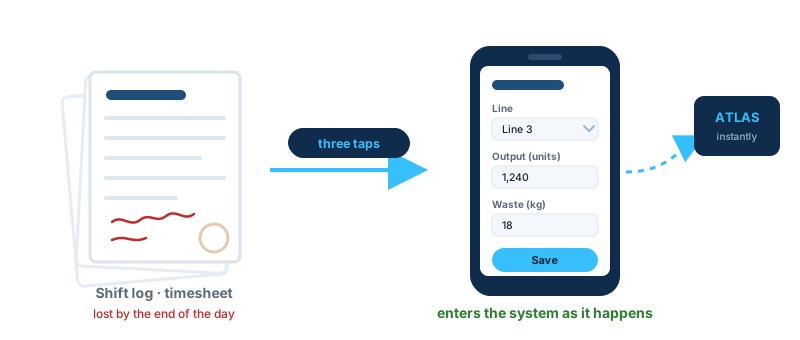
ATLAS captures data where it is born: the shift log, the timesheet and the delivery note move onto a screen.
In every company some data is in the system, some is in a spreadsheet, and some is nowhere: in the shift log, on a delivery note, in the foreman's head, in a messaging group.
That data is gone by the end of the day. Nobody remembers it by month-end. And by the end of the year the question “how much waste did we have?” has no answer — only guesses.
Filled in out in the field, at the head of the line, in the warehouse. Nothing to install — it opens in the browser.
The operator sees only their own form; the manager sees all of them. Who entered what, and when, is on record.
Instead of filling in 12 spreadsheet columns, screens that ask the right question in the right order. Bad entries are prevented up front.
What is entered lands directly in the system. Nobody transcribes it into a spreadsheet in the evening; nobody collects paper at month-end.

The operator does not wait for the end of the shift. Output, waste and downtime are entered from the tablet at the line, and the record reaches the centre in the same second.
In most manufacturing companies this is the pilot department — because this is where the most data is lost.
During implementation we walk through each department's work end to end: where does the information start, who writes it down, where does it go, where does it get lost? Drawing that map is worth something on its own.
Output, waste records, downtime reasons, delivery confirmations, timesheets — all of it is at the centre the moment it is recorded.
The same information is no longer written into three different places. Entered once, visible everywhere.
No waiting for the end of the day, the week or the month. You see what is happening now, now.
Production's “unit” and sales' “unit” mean the same thing. The argument is over.
Who entered what and when is on record. Accountability becomes clear and auditing becomes easy.
Manual copying, typing into the wrong cell, losing a piece of paper — the source of those errors disappears.
ATLAS is not imposed on every department at once from the top down. We start with the department that hurts most (in most manufacturing companies that is production), the team sees it working, and then we move to the next one.
We pick the department losing the most data.
The team sees the benefit with their own eyes.
Resistance drops; now the team is asking for it.
Departments are added one by one.
Entry screens are an option, not a requirement. A department that wants to carry on in Excel carries on in Excel — ATLAS reads that too.